skipped to
Departments
Fire Department Directory
Interested in volunteering?
Each department manages its own recruitment, so if volunteer firefighting is the right challenge for you, contact your local department. Unsure which department serves your area? Find it on our service map here.
Big Tancook Island Emergency Response Association
Website [ https://www.facebook.com/TancookFire ]
This email address is being protected from spambots. You need JavaScript enabled to view it.
Blockhouse & District Fire Department
Website [ https://blockhousefire.ca ]
Phone: (902) 624-9227
Email: This email address is being protected from spambots. You need JavaScript enabled to view it.
Conquerall Bank Fire Department
Website [ https://www.facebook.com/Conquerallbankfiredepartment ]
Phone: (902) 543-5295
Email: This email address is being protected from spambots. You need JavaScript enabled to view it.
Cornwall & District Fire Department
Website [ https://cdfd.ca ]
Phone: (902) 624-9373
Email: This email address is being protected from spambots. You need JavaScript enabled to view it.
Dayspring & District Fire Department
Website: [ https://dayspringfire.ca ]
Phone: (902) 543-4850
Email: This email address is being protected from spambots. You need JavaScript enabled to view it.
Hebbs Cross Fire Department
Website [ https://www.facebook.com/hebbscrossfire ]
Phone: (902) 298-3079
Hebbville Fire Department
Website [ https://www.facebook.com/HebbvilleFire ]
Phone: (902) 298-9418
Hemford & District Fire Department
Website [ https://www.facebook.com/hdvfd1952 ]
Phone: (902) 644-3433
Email: This email address is being protected from spambots. You need JavaScript enabled to view it.
Indian Point Fire Department
Website: [ https://www.indianpointfd.ca ]
Phone: (902) 624-9356
Email: This email address is being protected from spambots. You need JavaScript enabled to view it.
Italy Cross / Middlewood Fire Department
Website [ https://www.facebook.com/italycrossfire ]
Phone: (902) 543-2853
Email: This email address is being protected from spambots. You need JavaScript enabled to view it.
LaHave Fire Department
Website [ https://www.lahavefire.ca ]
Phone: (902) 529-0915
Email: This email address is being protected from spambots. You need JavaScript enabled to view it.
Lapland & District Fire Department
Website [ https://www.facebook.com/groups/292801682617981 ]
Phone: (902) 212-2040
Martins River Fire Commission
Website [ www.facebook.com/MartinsRiverFire ]
Phone: (902) 627-2770
Email: This email address is being protected from spambots. You need JavaScript enabled to view it.
Midville & District Fire Department
Website [ https://www.facebook.com/groups/237335213024194 ]
Phone: (902) 398-0278
New Germany Fire Department
Website [ https://newgermanyfire.ca ]
Phone: (902) 644-3301
Email: This email address is being protected from spambots. You need JavaScript enabled to view it.
Northfield District Fire Department
Website [ http://www.northfieldfirerescue.ca ]
Phone: (902) 902-543-9606
Email: This email address is being protected from spambots. You need JavaScript enabled to view it.
Oakhill & District Fire Department
Website [ https://oakhillfire.ca ]
Phone: (902) 543-8989
Email: This email address is being protected from spambots. You need JavaScript enabled to view it. or This email address is being protected from spambots. You need JavaScript enabled to view it.
Petite Riviere Fire Department
Website [ https://www.facebook.com/prvfdept ]
Phone: (902) 688-2741
Email: This email address is being protected from spambots. You need JavaScript enabled to view it.
Pleasantville & District Fire Department
Website [ https://pleasantvillefire.ca/volunteer-recruitment ]
Phone: (902) 543-7408
Email: This email address is being protected from spambots. You need JavaScript enabled to view it.
Riverport & District Fire Protection Commission
Website [ https://www.riverportfiredepartment.ca/ ]
Email: This email address is being protected from spambots. You need JavaScript enabled to view it. or This email address is being protected from spambots. You need JavaScript enabled to view it.
Tri District Fire Rescue
Website [ https://www.facebook.com/groups/505746916165093/about ]
Phone: (902) 527-6350
United Communities Fire Department
Website [ https://www.facebook.com/people/United-Communities-Fire-Department/100084381421374/ ]
Phone: (902) 298-6691
Walden Fire Department
Website [ https://www.facebook.com/waldenvolunteerfiredept ]
Phone: (902) 529-0353
Email: This email address is being protected from spambots. You need JavaScript enabled to view it.
Climate Action Dashboard
How is the Municipality of the District of Lunenburg acting on climate change? Our Climate Action Dashboard shows you, and it's open to everyone.
The dashboard tracks progress on the Local Climate Change Action Plan 2030 (LCCAP2030), which Council adopted on November 8, 2022. You can see what's planned, what's under way and what's been finished.
What you'll find
- Community Action Plan. Work on homes and buildings, transportation, land, water and nature, and local resilience.
- Corporate Action Plan. How the Municipality is reducing emissions in its own facilities, fleet and operations.
- Progress at a glance. Every action shows a status, such as In Progress or Complete, along with indicators that show results.
- Plans and reports. The full plan and past annual progress reports.
Choose a focus area, select an action, and see what's been done and what comes next. The dashboard works on a computer or a phone.

Questions or feedback about the dashboard? Email This email address is being protected from spambots. You need JavaScript enabled to view it.. We'd love to hear from you.
Bike Loan Program
In collaboration with LCLC and the Town of Bridgewater, we are launching a full bike loan program. We have the following bikes available (click the bike type for more details):
Where to borrow an e-bike:
Lunenburg County Lifestyle Centre (LCLC), 135 N Park St, Bridgewater
How to book:
- In person: LCLC Guest Services
- Phone: 902-530-4100
E-bike Eligibility:
- Ages 16+
- Ages 16–17 require parent/guardian co-signature
- Government issued ID number required for waiver form
pdf Frequently Asked Questions (Ebikes) (79 KB)
Same Day Pick ups and Returns
- Bikes must be booked at least one day in advance and are subject to availability.
- Bikes loans must be picked up and returned on the same day.
Loan Times
- Tuesdays: 10:30am – 4:30pm
- Wednesdays: 10:30am – 4:30pm
- Thursdays: 4:00pm – 6:00pm
Please note that the e-bikes are generally larger and heavier than standard bicycles and have wider tires. Because of their size, most standard bike racks are not suitable for transport.
We are excited to announce our partnership with Lunenburg County Wheels, who can assist with e-bike pick-ups and returns. To book a ride, please give them a call and mention that you are using their service for the e-bike loan program, and we will subsidize the ride fare! Contact Lunenburg County Wheels at 902-523-4455.
As the program grows, additional booking and pickup options may become available. Stay tuned on the District of Lunenburg Parks, Recreation & Tourism Facebook page for updates!
Dashboard
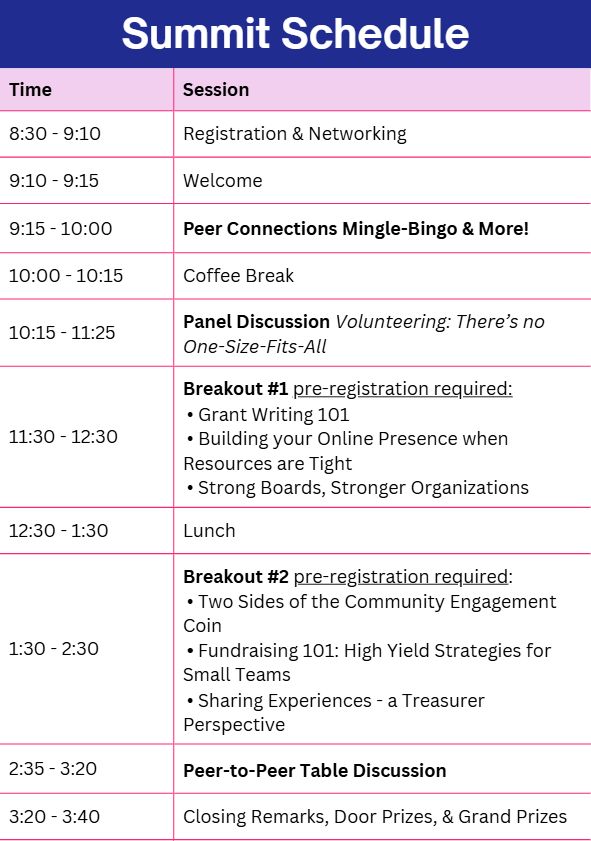
Volunteer Summit 2026

Saturday, November 7, 2026 | 8:30 a.m. – 4:00 p.m. | NSCC, Bridgewater
$15 including lunch | Limited Spaces | Registration open October 8th - 30th
What to Expect:
One day. Fresh ideas. New connections. Practical takeaways.
The Volunteer Summit is designed to give you a chance to step away from the day-to-day and connect with other volunteers who understand the rewards and challenges of running a volunteer organization.
Throughout the day, you’ll have opportunities to learn, share and connect through interactive workshops, panel discussions and peer-to-peer conversations. Explore practical topics such as grant writing, fundraising, online communications, board development, community engagement and nonprofit finances, while hearing directly from people with experience in these areas.
You’ll also have plenty of opportunities to meet other volunteers, exchange ideas and discover what organizations across Lunenburg and Queens Counties are doing in their communities. Our networking sessions are designed to be relaxed, interactive and useful - whether you’re looking to make a new connection, find a solution to a challenge or simply discover that other organizations are facing some of the same issues you are.
And, of course, there will be time to enjoy lunch, enter for door prizes and try your luck at winning $500 for your organization! With at least two $500 prizes up for grabs, there’s more than one chance to win. Just remember - you must be there to win!
You'll leave with fresh ideas, useful connections and practical takeaways you can bring back to your organization.
How to Register:
Registration open October 8th - 30th
Registration is available by phone or email. Before you register, please review the session descriptions below and have your morning and afternoon session choices ready. This will help us complete your registration quickly.
Registration: This email address is being protected from spambots. You need JavaScript enabled to view it. or 902-275-3490
Cost: $15, including lunch
If the registration fee is a barrier, free and subsidized spaces are available. Please ask about available options when registering.
Note: Full registration details at bottom of page.
Connecting, Sharing & Learning:
Summit Peer Session (morning) - Peer Connections – Mingle-Bingo & More!
We’re starting the day by getting to know the people in the room! This is your chance to meet fellow volunteers and organizations, share what you’re passionate about, and discover what others are working on in their communities.
Panel Discussion (morning) - Volunteering: There’s No One-Size-Fits-All
Recruitment and retention aren’t one-size-fits-all either. What motivates one person to volunteer may be very different from what motivates someone from another generation, background or stage of life. Hear from a diverse panel of volunteers about what motivates them to get involved, what they need from an organization, how they like to communicate, what barriers can get in the way and what makes them want to stay.
Summit Peer Session (afternoon) - Peer-to-Peer Table Discussions
Now it’s time to dig a little deeper! Building on the themes, ideas, and questions that surfaced during our morning session, this is your opportunity to explore the topics that matter most to you and your organization.
Morning Breakout Sessions:
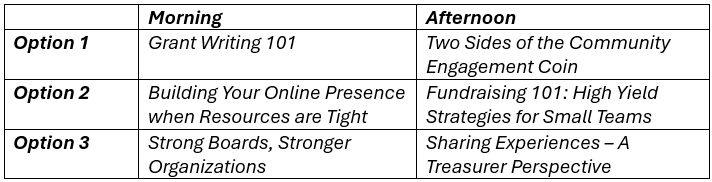
Choose ONE (See table below for descriptions):
1. Grant Writing 101
2. Building Your Online Presence When Resources Are Tight
3. Strong Boards, Stronger Organizations
| 1. Grant Writing 101 - Anna Haanstra, Regional Manager - Department of Communities, Culture, Tourism and Heritage with the Province of Nova Scotia |
|
If you are new to writing grants, or have some experience and want tips, this workshop is for you! Anna Haanstra, Regional Manager on the South Shore with the Province of NS, will share what to do before searching for grants, where to find grants, tips into how to submit a strong application, and answer common questions about what makes a successful application. This session will include a presentation, a practical budget activity (we will do some math!), and list of local grant sources to take with you. |
| 2. Building your Online Presence when Resources are Tight - Emily Sollows & Meghan Doucette, Co-Founders - Lemonade Co. |
|
Emily & Meghan bring 10+ years in non-profit communications experience to the table, working with local, regional and national organizations to help them communicate their impact, access new funding streams and connect their audience through heart-led, human centered communications and design. This hands-on workshop shows you how to get more from your social media and website without adding significantly to your workload. You'll leave with a clear sense of today's best practices and simple, low-lift strategies to reach more supporters and inspire them to donate, volunteer, and get involved. |
| 3. Strong Boards, Stronger Organizations - Lynn Wagner, President - South Shore United Football Club |
|
What makes a board work well, and what can get in the way? Drawing on her professional experience in Human Resources and her experience of serving on community boards, Lynn will share practical strategies for building stronger, more effective boards. Explore how to run productive meetings, build consensus, navigate conflict, manage difficult situations and foster respectful relationships between board members, staff and volunteers. The session will also look at shared leadership, succession planning and finding the next generation of board members. Come ready to share, ask questions and take away ideas you can put into practice with your own board. |
Afternoon Breakout Sessions:
Choose ONE (See table below for descriptions):
Two Sides of the Community Engagement Coin: Learning from and learning with community to strengthen your organization
Fundraising 101: High Yield Strategies for Small Teams
Sharing Experiences – A Treasurer Perspective
| 1. Two Sides of the Community Engagement Coin - Jessie Grigg-Farquah, Executive Director – Fort Point Museum & Rob K. – The 644 Revitalization Network |
|
In this moderated Q&A session, you’ll get to learn from two local community groups that have successfully used community engagement as a tool to grow their volunteer base and develop strategic direction that connects with their local community. If you’re wondering why your programming is falling flat, volunteers are disappearing, or your vision isn’t resonating with your network, come ask questions to Jessie from Fort Point Museum and Rob from the 644 Network who can share how their organizations have harnessed the power of community engagement to become anchor organizations for LaHave and New Germany. |
| 2. Fundraising 101: High Yield Strategies for Small Teams - Liz Finney, Fund Development Director - Bonny Lea Farm |
|
Over the past 10+ years, Liz has helped grow Bonny Lea Farm’s annual campaign, event revenues and legacy gifts, and stewarded a successful $4.5 million capital campaign! She’s excited to learn what challenges you are facing and share some achievable actions that will bring results to your organization. Liz understands that big missions don't always come with big fundraising teams. In this 60-minute session, we’ll share a few high-yield tactics to help small nonprofits keep donors engaged, ask for support with confidence, and make the most of limited resources. Includes time for discussion and Q&A. |
| 3. Sharing Experiences – A Treasurer Perspective - Don Davison – Dayspring & District Fire Department |
|
Don has spent 15 years supporting the Dayspring & District Fire Department. Twelve years as a Commissioner and six of those as Treasurer. This session will cover the basics of claiming your HST rebate, completing charitable tax returns, and will facilitate much needed discussions about the questions we all avoid when it comes to non-profit accounting. Come with your burning questions and join this session for a non-judgemental conversation about your organization’s finances. Topics will include:
|
Ready to Register?
Registration is open October 8th – October 30th
Cost: $15 per person, including lunch
Payment methods accepted: Credit/Debit, ETransfer, Cheque, Cash
To register, please contact:
902-275-3490 or This email address is being protected from spambots. You need JavaScript enabled to view it.
When registering, please have the following information ready:
- Your name
- Organization you are representing
- Contact information
- Your preferred morning session
- Your preferred afternoon session
- Any dietary requirements
- Any accessibility needs
Need help with the registration fee?
We have a limited number of free and subsidized spaces available. If cost is a barrier, please ask about these options when you register. We want the Summit to be accessible to volunteers from across our region.
Space is limited to 100 participants, so don't wait to register!

Winter Activities

- Rails to Trails Network
- MARC in Dayspring
- River Ridge Common in Pinehurst
- Miller Point Peace Park in Dayspring
- LaHave Sunset Park in Conquerall Bank

Water Recreation


LAKES:
- Wiles Lake Park in Wileville
- Molega Lake Park in Molega Lake
- Church Lake in Newburne
- Sucker Lake in Upper Northfield
- Mushamush Beach Park in Sweetland

OCEAN:
- United Communities Marine Park in Voglers Cove
- Sawpit Wharf Park in Garden Lots
- Hirtle’s Beach in Kingsburg
- Rose Bay Marine Park in Rose Bay
- Old Southeast Cove Wharf Day Park on Big Tancook Island
- Oakland Conservation Area in Oakland

RIVERS:
- LaHave Sunset Park in Conquerall Bank
- Miller Point Peace Park in Dayspring
- Petite Riviere Community Park in Petite Riviere

WATERFALLS:
- Indian Falls in Newburne
- Indian Brook Falls at River Ridge Common in Pinehurst
Play Parks, & Sports

- MARC Ballfields in Dayspring
- River Ridge Common in Pinehurst
Biking

- MARC in Dayspring
- River Ridge Common in Pinehurst
- Trails (multi use)
- Miller Point Peace Park in Dayspring
- Indian Point Rest Stop in Indian Point
Hiking / Walking

- Indian Path Common in Indian Path
- Indian Falls, Newburne
- MARC in Dayspring
- Miller Point Peace Park in Dayspring
- River Ridge Common in Pinehurst
- Arthur Young Trail in Cookville
- Gaff Point at Hirtles Beach in Kingsburg
- Trails (multi-use)
- Geocache Challenge
- District of Lunenburg Hike/Hike Nova Scotia Challenge

More Articles ...
- Coastal Protection
- What is Planning?
- Tax Installment Prepayment Plan Enrollment Form
- Tax Installment Prepayment Plan (TIPP) - Change or Cancel TIPP Request Form
- PRO Fund
- Community Engagement
- Energy Efficient Homes and Buildings
- Climate Change and Sustainability
- Roof-mounted Solar Panels
- Short-term Rentals
- Application for a Building, Development or Demolition Permit
- Flood Risk